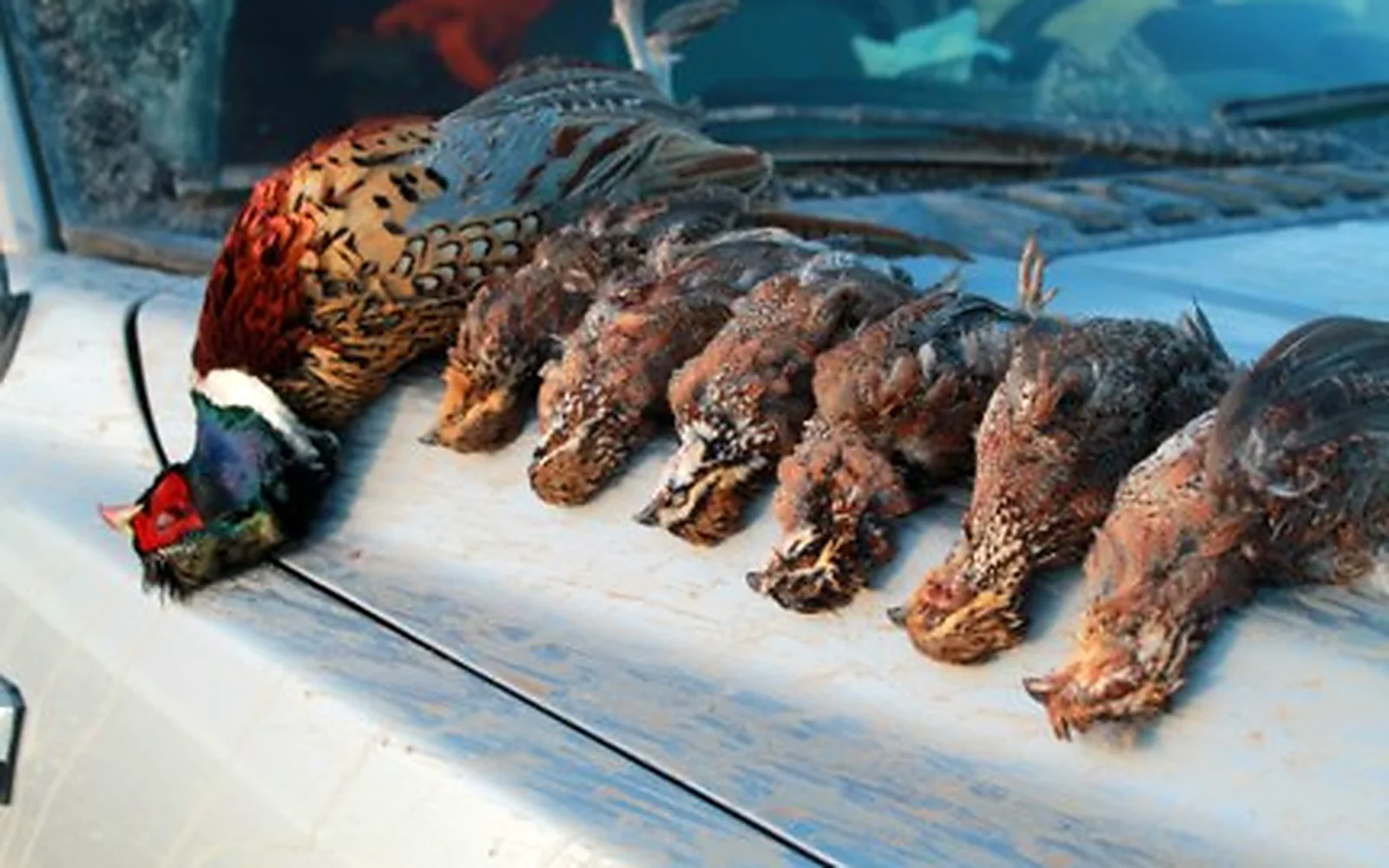
How Bobwhite quail scratch out a living in southeast Colorado, and the tips and tactics I use to find them.
Introduction to the Bird
Bobwhite quail are native to North America and are found from southern Mexico to Nebraska and the Atlantic coast to eastern Colorado, with some populations persisting in Oregon and Washington as well. Best known as a bird of southern states like Georgia, Alabama, and Mississippi, the term “Gentleman Bob” applies perfectly to the tight holding, quick flying upland bird. Bobwhites are (in my opinion) best hunted with a solid standing pointing dog, and with a small group of hunters. Long lines of marching walkers and standing blockers need to be left in the pheasant fields, as bobwhites lend themselves to a more intimate hunt shared with a close friend and a dog or two. As a Colorado hunter looking to chase bobwhites out of state, I would urge you to read this article and think about chasing “King Bob” in eastern Colorado.
As a kid that grew up hunting scaled quail, once I discovered the bobwhites living right under my nose, I couldn’t help but dive in headfirst and drink the cool aid that is bobwhite biology and habitat. And this article is an overview of what I have learned about the game bird that has grown near and dear to my heart. I would be remise if I didn’t give my mentor and close friend Jonathan Reitz credit for much of the content I will cover in this article. I am also very confident he will be pleased with me sharing some information he has passed down to me.
Bobwhites are found in two main types of habitats in Eastern Colorado: riparian areas along main river drainages, and CRP/sand sage grasslands. These habitats can be strikingly different, from thick tamarisk-choked river bottom to wide open grasslands; it can be a real challenge to focus on specific features as a hunter. However, I believe once you understand the day-to-day movements of bobwhites, you can better focus your hunting efforts based off biology of the bird, leading you to target specific aspects and features that both riparian areas and CRP habitats offer.
A Day in the Life of a Bobwhite Quail
Bobwhites, assuming they weren’t flushed by a predator overnight, start their days slightly before sunrise huddle in a small circle, with tail feathers pointed to the middle of the circle and beaks faced outwards. This strategy helps them regulate body heat. It also creates challenges when a predator discovers and consequently flushes the covey. With wing beats and feathers going in all different directions, it is hard for a predator to pick just one bird. With it being unable to single out one individual, the predator often misses, which is a feeling any honest bobwhite hunter is all too familiar with. This results in a disturbed covey, but all the members hopefully survive till dawn. Once things warm up a bit and the sun begins to rise, the morning head count starts. Like your third-grade teacher gathering everyone from recess to head to breakfast, this whistle call gathers the singles and other coveys into formation. At this point, these birds are moving a fair bit, and while an observant hunter could use the whistles to target noisy members of the covey, it can be challenging to catch up with the birds at this time of day. Rather, I personally choose to target pheasants at the beginning of day, for there is better quail hunting to come as the day matures. As the covey assembles, they head to gravel and food sources. While the early morning can be a good time to stop and listen to birds, it can also be a great time to cruise down roads and locate a covey along roadways. Food sources can vary depending on habitat the quail call home. In rangeland or riparian habitats, forbs like sunflowers, flax, snowberry, tooth spurge, or other seed producing forbs offer a buffet of resources to the birds. More commonly, you’ll find birds in an agriculture setting, taking advantage of sorghum, corn, or millet. Also, don’t overlook wheat stubble, as it offers great cover and missed grain offers great food. Additionally, a golden nugget of advice is to pay close attention to areas within the crop field that are “dirty” or “weedy”. These areas offer both agriculture and native food sources, giving the birds options and diversity. I would rather boot the dogs up and hunt a sticker batch with spotty sorghum, over the pristine, clean, picture-perfect field across the road, if all else is equal. Truth is, I would probably hunt them both but choose the weedy field first. I have had good luck hunting bobwhites in food sources, but most of this success is a by-product of hunting pheasants in the same cover. It’s a solid strategy but offers a short window of time with birds moving around. Being a few minutes early or late can result in missing the birds and coming out empty. But don’t worry, once these bobwhites fill their crops for the day, the real fun begins.
By 9:30 AM coveys will generally be in or begin to move to loafing cover. Loafing covers offer overhead protection, but enough room and space at ground level to move around and be social. This can take the shape of many different things: along riparian areas think Tamarisk, Russian olive, down trees, phragmites grasses, and abandoned irrigation infrastructure. In CRP country, think abandoned house spots, tree and shrub rows, fourwing saltbush, old farm equipment, train box cars, abandoned buses, anything that offers protection from the sky, and has escape routes along the ground. When a predator comes around, the quail want to be able to hold tight in hopes of going unnoticed, but if discovered, they wait for the predator to close the gap. Once within striking range, the birds will flush, rather than run, out the back door, leaving the predator confused and dazed by the commotion. A key part of the equation is the structure of the cover. Too thin of structure and the predator isn’t slowed down enough, allowing the interaction to become a fair fight. Too dense of cover, and the birds can’t all flush at once, leaving stranglers behind to become lunch. Think of a wooden teepee constructed of 2x4s, with equal space allocated between 2x4s and openings for doors in and out of the teepee. No chance of a raptor getting in from above, dense enough to slow a coyote down, easy for birds to move in and out in any given direction, while also having space within the structure for birds to move easily. Sumac, sandhill plums, and fourwing saltbush are all great examples of shrubs that provide this dynamic cover. Surrounding these quail palaces, waist high grass is preferred, and while not a necessity, I have found that some bare ground interspersed is not a negative attribute either. Bobwhites will be found in these loafing structures from approximately 9:30 AM – 3:15 PM. These times vary, but you’ll rarely find me chasing pheasants in shrub-less habitat passed 10:00 AM. When the clock reads 9:30 AM, my mind goes straight to quail in loafing cover. This timeframe is longer, much of the day in fact, and in my eyes that’s why it’s so important. You will consistently find birds, and you have a lot of the day to do it. This strategy also allows a hunter to explore some unknown country and still find success. A hunter doesn’t have to be timely or punctual, either. He can wake up and cook breakfast for the family, mosey out to the field, have a productive and enjoyable hunt, and be home in time to watch Sunday night football.
As the day progresses past 3:15-3:30 PM, those quail once again move out to feed. I feel like this feeding window is much shorter, and the quail moves a shorter distance than the morning feed. I look at this as a chance for them to top off supplies and prepare for the long night ahead. I find this feeding window to be difficult to target bobwhites and find consistent success for the same reasons as in the morning. Shorter time frame, moving birds, much more ground to cover. However, I have found that shortly after this time frame can be special. As the birds return to grass to hunker down for the night, a hunter can find himself in a great situation.
A dragon that I chase in the afternoons is something I have referred to as the “magic hour.” Real original, I know. But my magic hour is this: as birds return from their afternoon feeds, a hunter can walk, then re-walk, and sometimes walk for a third time, the exact same cover and have different groups of birds entering that cover at different times. This works for both pheasants and quail, sometimes at the same time, if the cover is right. The best cover for this situation is fair to good grass, knee high to waist high, with a fair bit of open ground mixed in. Again, biology of quail ties closely to why this is so. When quail are looking for a roost site, they are factoring in escaping predator harassment into their decision. They want grass for thermal cover but if the grass is too thick or tall they can’t escape efficiently in the dark. For this same reason, quail DO NOT use loafing structures at night. A fourwing saltbush that is a quail mansion during the mid-day, is a death trap at night. Woody branches and dense cover become unseen obstacles at night, leading to impacts during the flush, and in the worst case, broken wings or predator captures. Grass that would not be great cover during the day, can be perfect for roosting cover at night. Pheasants do use cover that’s a bit thicker at night, so finding a field that is both thin enough for bobwhites to roost in, while also thick enough for pheasants to feel comfortable in, can be tricky. Their preferences do overlap and if other factors like food and pressure are great enough influences, this overlap can lead to a very fun and productive last hour of light. As a side note, be prepared for pheasants when hunting bobwhites; a bonus rooster is always a nice addition to the bag. Pheasants are less dependent on woody structures but still utilize them from time to time.
CRP vs River Bottom Strategies for Success
Even with drastically different plant communities, the strategy for success stays the same. Find woody cover, approach with the wind favorable for the dog, and cover ground. I know some readers are thinking about the river bottom habitat they have hunted and are thinking: “Dang, Trey. What you just described is exactly what 95% of the Arkansas or South Platte River bottom looks like, real helpful man, thanks for nothing!” And you would be right; it can be tricky figuring out exactly where these birds consistently spend their time. There’s seemingly an endless amount of woody cover in the ecosystem. But I do have some more tips on where to focus.
For starters, cover some ground; some coveys are just in a random spot. There is no rhyme nor reason that I can perceive for why they choose that specific Russian olive to hang out under. Theres 65 other ones that look the same, but that one specifically is the “magic tree.” Maybe it has the best view; maybe it produces the sweetest tasting olives on the river bottom. Which, to be clear, is something I have seriously considered and debated on figuring out for myself. I have yet to follow through with these thoughts, but the idea is not dead in my mind either. Regardless of reasoning, once you find this tree, a lot of hard work is done. That covey will, in my experience, consistently be there time and time again. And if not in that specific tree, they will be close, think within 200-300 yards. However, with great power comes great responsibility; do not abuse this knowledge. If handled responsibly, this covey will be there for years to come, if habitat and food are consistently available of course. Over hunting a hot spot can lead to quail-less hot spots in future years, and please just trust me on this one, I learned this the hard way.
Another tip I have is to figure out what food source those birds are hitting the most. Quail aren’t forced to drive across town for breakfast, if the habitat is present, they will put up shop close by, saving their energy for predator encounters and cold winter days. Once you have seen birds in a specific food, extrapolate that information to other areas and target those loafing structures within 200-300 yards of that food. Consider learning some native food sources as well, riparian areas have sneaky amounts of diversity at times, and in my experience these native food sources hold more power than agriculture, so study up and take notes of seed producing forbs. River bottom hunts can be challenging, tight shooting windows, challenging walking conditions, and seemingly endless loafing structure leads to an intimidating endeavor. In summation, focus on areas with grain crop production rather than alfalfa, with loafing structures that fit the described features, and don’t be scared to put some ground under your boots, for the quail will be there, you just need to find them.
In CRP dominated landscapes, this approach is very consistent and straight forward. It is harder to find woody loafing structures, unless a concerted effort is made to add it to the landscape. At the point you do find woody structure, finding the quail is the easy part. Please, for the love of all things sacred in the hunting world, never pass up a public accessible farmsteads, corrals, tree/shrub rows, or other things that satisfy the requirements for quality loafing cover. Yes, these areas will experience higher levels of pressure because they stick out like a sore thumb in agriculture’s landscape, but they will hold birds. Something as simple as a windmill stand with weeds grown up between the legs provides the cover required for birds. Tumbleweeds blown into a corner of a field held up by strands of fence, have consistently been great loafing structures for bobwhites and scaled quail alike, in my experience. Remember, the structure doesn’t have to be much taller that the quail themselves. If the birds can stand comfortably under the structure, they can and will use it. These prior examples are all unconventional or maybe overlooked, but the real money is made when shrubs like fourwing saltbush are present on the landscape. Planted specifically for bobwhites, fourwing saltbush can be found in some of the CRP planted in southeast Colorado, and these become multi-million-dollar mansions in the eyes of bobwhites. Similarly, rows of sumac and sandhill plums are also golden opportunities to find birds. Finally, mature stands of sand-sage rangeland provide unique opportunities to harvest bobwhites along some of the more prominent creeks and tributaries feeding into the main rivers of Eastern Colorado. Sand sage habitat is the only opportunity I have had to harvest both bobwhites and scaled quail on the same walk, although the opportunity does exist within other overlapping habitat areas.
The Wrap Up
A savvy quail hunter is looking for good food sources with loafing structure close by. The presence of loafing structures should outweigh the hunter’s affinity for prime looking cropland because loafing structures are far rarer than prime crop fields. He may also sleep in, and delay his hunting until 8:30 or 9:00 AM, or choose to chase inferior species like pheasants first thing in the morning. Once the clock strikes nine, his mind should then move to finding some loafing structure. A strong pointing dog, with patience and confidence in his hunter, makes this experience much more enjoyable as well. Bobwhites, in general, don’t run like pheasants and scaled quail, and once found by the dog, they hold tight. Too much pressure by an eager or young dog will result in a wild flush, not allowing the hunter to be in range. Very rarely do bobwhites stagger flush; it’s a one and done deal. Bobwhites are creatures of the edge as well, and targeting loafing structures along field edges closest to cropland is wise. However, the hunter shouldn’t totally exclude the middle of large fields either. Native food sources that are less obvious may be present in disturbed areas in CRP or native range. He would also be wise to consider screening cover between the two habitat features. Woody cover that is separated from crop land with 80 yards of bare ground may be less desirable. On the other hand, woody cover that is separated by 160 yards of shin-high grass or cover could be much more desirable to a covey of quail. The covey’s ability to move safely and comfortably through an area is an important consideration. The hunter could responsibly hunt for the rest of legal light, especially early in the season, but one would be wise to consider giving the birds a break as dusk approaches. Allowing the birds to covey up before dark and assemble their “bobwhite ring of warmth” is an important part of their biology and should be a consideration when hunting cold snaps or late season.
Good luck to all the hunters heading out for opening day in Colorado, 2026. Bird numbers are strong; bobwhites specifically. Be safe, have fun, and enjoy the outdoors!